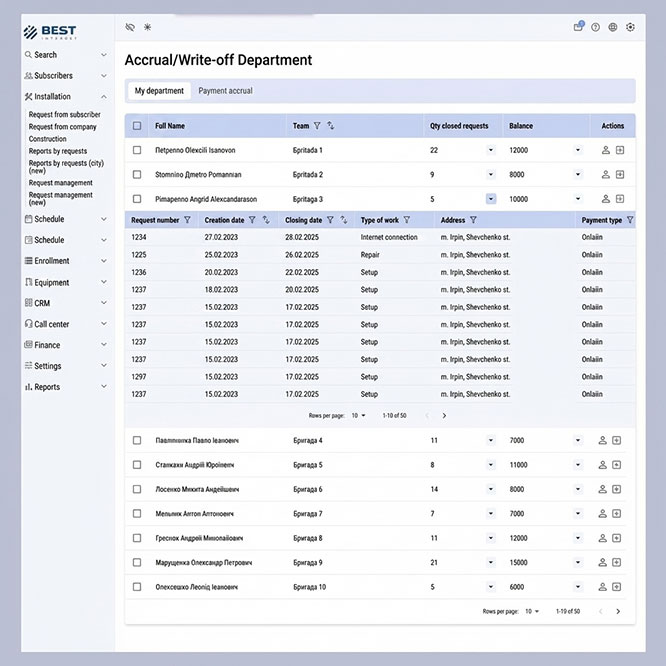
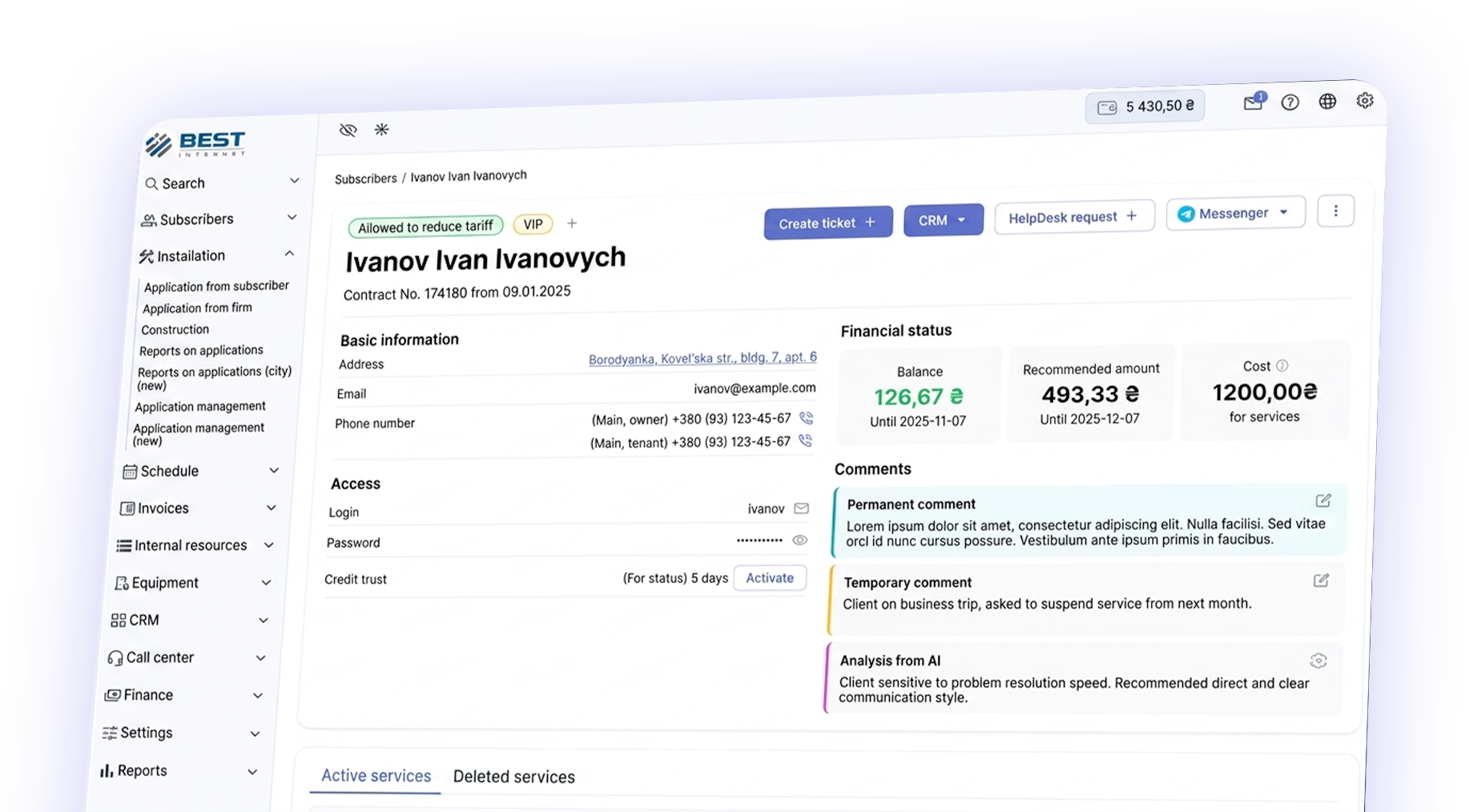
Basic Version of AllBill Includes:

Tariff Constructor

A module for centralized configuration of billing rules and client payment calculations.

CRM (Basic)

Basic CRM is a module for managing the customer database and recording the history of client interactions.

Financial System

An internal closed transactional accounting module that provides full control over the movement of funds.

Payment Acceptance

Provides integration of the billing system with payment providers and payment channels.

User Frame

A branded module that brings together the full workflow for individual clients (B2C) in a single interface.

Provisioning

A module for operational management of subscriber internet sessions.

Coverage Map

A module for building and maintaining an up-to-date map of the provider's network coverage.

Base Report Analytics

A basic system analytics module designed for real-time monitoring of key metrics.
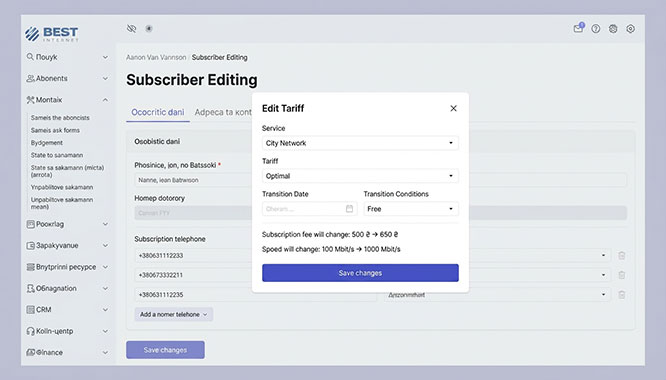
The Tariff Constructor is a module for centralized configuration of billing rules and customer payment calculations within the billing system.

The module supports two main types of charges:

  • Daily billing – automatic deduction of service costs for the actual days used.
  • Monthly billing (prepaid) – full deduction of service costs for the billing period in advance.

Thanks to a flexible set of billing parameters, the operator can set different prices and conditions depending on:

  • city/locality (regional price differences);
  • network type or connection zone (e.g., private sector or urban network);
  • type of service (internet, additional services, etc.).

The module provides a single source of billing rules for all connections and allows quick scaling of billing policy across different geographies and subscriber segments without manual recalculations.
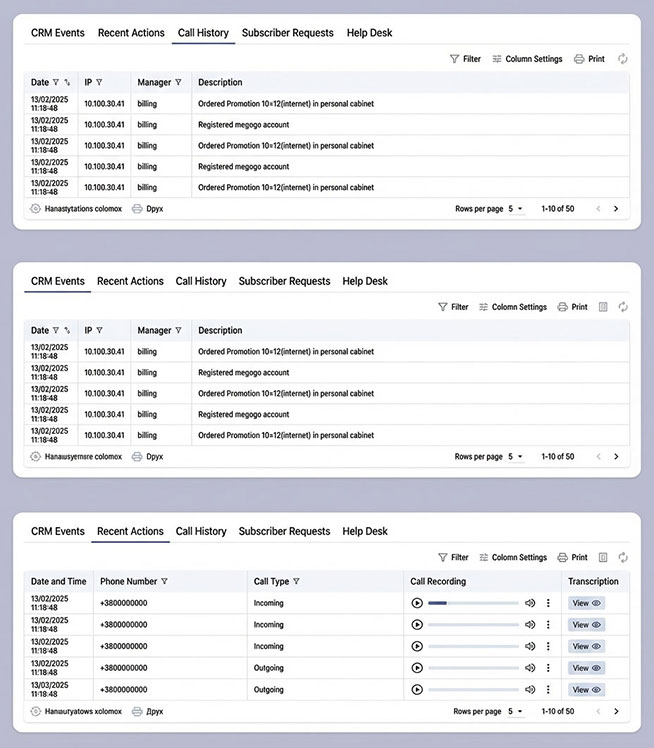
Basic CRM is a module for managing the customer database and recording the history of client interactions.

The solution provides centralized data storage and communication transparency within the billing system.

Module features:

  • maintaining a customer profile and updating core data;
  • managing customer contact persons (full name, position, phone numbers, email, notes);
  • interaction logging (calls, correspondence, inquiries, meetings) with the ability to add comments;
  • questionnaires (collection and storage of additional data using templates/surveys);
  • document management (storing and linking documents to a client, tracking statuses and versions according to internal rules).

Basic CRM limitations:

  • the module does not include sales pipeline functionality;
  • the module does not include call campaigns;
  • the module does not include processing (automated operation handling/routing scenarios).

The Financial System is an internal closed transactional accounting module that provides full control over the movement of funds within the billing platform.

The system operates as an internal financial circuit: funds do not “pass through from outside” or “go out” within the module — only accounting events and their impact on the subscriber’s balance are recorded.

Key operating principles:

  • Full transactionality: every financial action is recorded as a transaction with a clear impact on the subscriber’s account.
  • Full traceability: any specific transaction, its cause, balance change, and account result can be tracked at any moment.
  • Mathematical control: the system is “mathematically controlled” — the subscriber’s balance can be recalculated from zero (0) by sequentially applying all transactions, and the resulting value will always match the current balance.
  • Audit transparency: the financial state of an account is formed solely on the basis of the transaction log, minimizing discrepancy risks and simplifying audits.

The module ensures stable, controlled balance accounting and serves as the foundation for correct charges, write-offs, and financial reporting within the billing system.
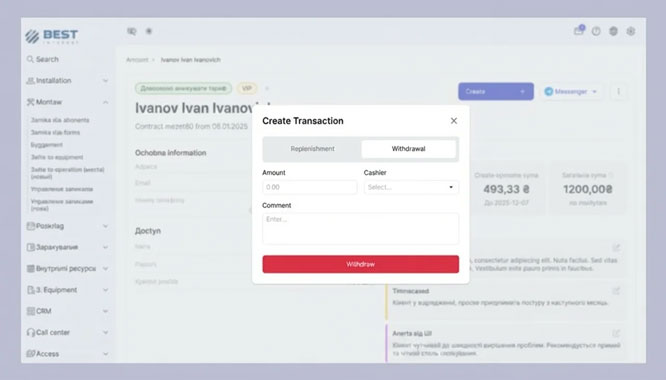
The Payment Acceptance module provides integration of the billing system with payment providers and payment channels

for automated crediting of subscriber payments and their subsequent reflection in the system’s financial circuit.

Integrated payment systems (currently):

  • Portmone – all available protocols supported, including Web and Checkout.
  • iPay – all available protocols supported, including Web, Masterpass, and Checkout.
  • EasyPay
  • PUMB
  • Privat24
  • iBox
  • monobank (mono)
  • MoneyUA
  • Platezhka
  • UkrPays
  • CityPay
  • Platon

The module supports scaling the list of providers without changing the core billing logic and ensures unified payment display regardless of the incoming channel.
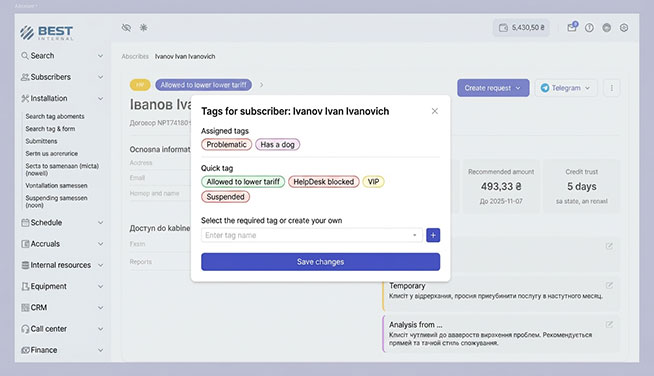
User Frame is a branded platform module that brings together the full workflow for individual clients (B2C) in a single interface.

The module is built as an end-to-end process that leverages the capabilities of all key system components and provides a standardized approach to subscriber service.

User Frame includes specialized sections and functionality for individual clients, including:

  • an individual clients page/registry and subscriber profile;
  • management of individual client services;
  • tariff constructor and B2C billing rules;
  • payment acceptance for individual clients with results reflected in the financial circuit.

The module provides a full set of tools needed for day-to-day work with individual users, including:

  • basic CRM functionality within the subscriber profile;
  • maintaining interaction history and contact information;
  • service management and connection parameters;
  • accounting and viewing of internet sessions (if the relevant data collection service is available);
  • financial history (charges, write-offs, payments, adjustments) with full traceability;
  • phone book and contact details;
  • integrations with chatbots and communication channels (if connected modules are available).

User Frame forms a unified workspace for support, sales, and accounting control in the individual client segment, ensuring transparent accounting, fast service, and process standardization.
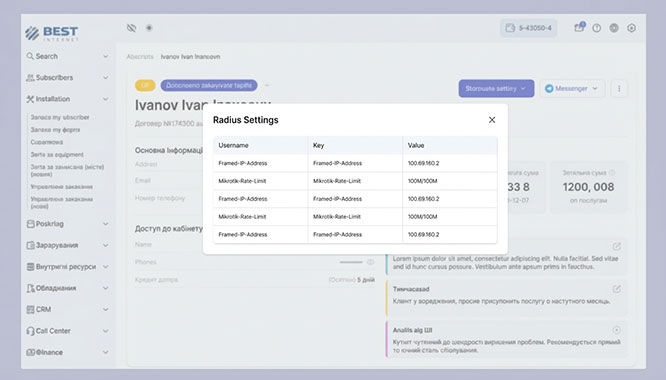
Provisioning is a module for operational management of subscriber internet sessions,

providing speed shaping, service blocking/unblocking, and centralized interaction with the provider’s network infrastructure. The module is built around FreeRADIUS ↔ BRAS integration and provides full support for RADIUS protocols and mechanisms.

Key module capabilities:

  • Full RADIUS integration for authorization, session accounting, and applying access policies.
  • Speed shaping and automatic application of tariff parameters to an active session.
  • Guest sessions (temporary access under defined rules).
  • Real-time session and service blocking/unblocking.
  • On-the-fly operation without delays or service interruption: for example, when a tariff changes, the speed is updated automatically without dropping the current session.

Supported authorization scenarios:

  • user authorization by MAC address;
  • authorization by Option 82;
  • authorization by the “2 of 3” rule (ID / MAC / Option 82).

Session lifecycle automation:

  • automatic session start/restart for new users or when access parameters change, according to system rules.

IP management:

  • IP address pool management module;
  • IP address ranging/distribution by cities, subscribers, and services according to the provider’s policy.

Technical architecture: In the base configuration, the module runs on our FreeRADIUS build with proprietary control modules. Any solution that supports FreeRADIUS / RADIUS protocol can be used as the BRAS, with no vendor lock-in.

Coverage Map is a module for building and maintaining an up-to-date map of the provider's network coverage.

The module is used as a reference and operational foundation for correctly creating services, and for automating customer self-service scenarios.

Key purpose of the module:

  • displaying and managing the provider’s coverage zones linked to address logic;
  • determining service availability in a specific location for correct connection setup and billing.

Practical applications:

  • the module is a mandatory component for creating/configuring services in the system with regard to geographic coverage;
  • enables independent request creation and service ordering by clients via a website or self-service portal (e.g., checking connection availability by address, selecting available services, submitting a request).

Coverage Map provides a single source of coverage data, increases connection accuracy, and reduces the amount of manual verification by operators.
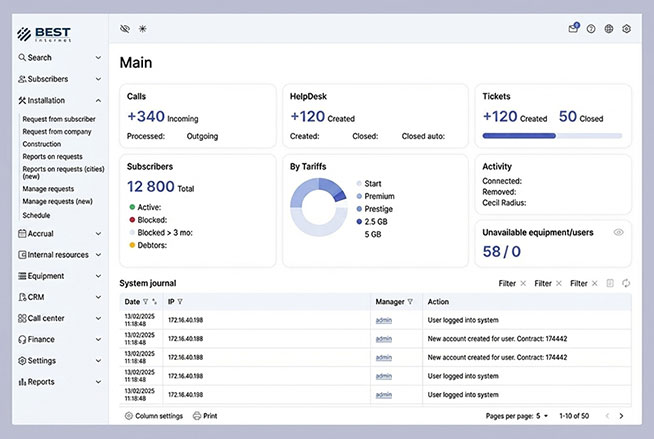
Base Report Analytics is a basic system analytics module designed for real-time monitoring of key metrics without the use of "heavy" extended reports.

The module provides a standard set of reports required for the daily operations of financial and technical departments.

The module includes the following basic reports:

1) Financial Analytics

  • analytics of incoming payments with breakdown by payment system;
  • ability to monitor payment dynamics and reconcile actual receipts by channel.

2) RADIUS Analytics

  • guest sessions: accounting of unauthorized users (when internet access is blocked), for monitoring inquiries/connections and diagnostics;
  • active sessions: current connections and aggregated statistics by city;
  • session history: client session log for further analysis of service quality, load, and incidents.

The module provides quick access to key operational information and establishes a basic level of system manageability without implementing complex BI solutions.